

Get Latest [Apr-2026] Conduct effective penetration tests using PracticeDump AACE-PSP
Penetration testers simulate AACE-PSP exam PDF
The PSP certification exam is a rigorous and comprehensive test that covers a wide range of topics related to project planning and scheduling. AACE-PSP exam is designed to evaluate the candidate's ability to apply industry-standard techniques and best practices in the planning and scheduling of projects. AACE-PSP exam covers topics such as project planning, scheduling, progress monitoring, and analysis, as well as cost and risk analysis.
Preparing for the AACE-PSP Certification Exam requires dedication and commitment. Candidates must study the AACE International body of knowledge for planning and scheduling, attend training courses, and practice with sample questions and mock exams. AACE International offers various training courses and materials to help candidates prepare for the exam. These include online courses, reference books, and practice exams.
NEW QUESTION # 10
Which of the following documents is most likely to be of the LEAST value to a planner/scheduler when planning a contractor's baseline critical path schedule for the construction of a large high-clearance bridge located very near an airport? The contractor has been awarded the contract.
- A. The project geotechnical report
- B. The project plans and specifications
- C. The government's report on future high-clearance bridge projects
- D. The regulations published by the government aviation agency
Answer: C
NEW QUESTION # 11
Using the normal schedule, given Activity 3001 and the relationship with Activity 4001. what is indicated?
- A. These activities are partially concurrent, with Activity 4001 starting 15 days after the start of Activity 3001
- B. These activities are sequential, with Activity 4001 starting 15 days earlier than the start of Activity 3001.
- C. The activities are independent, with Activity 4001 starting 15 days earlier than the start of Activity 5001
Answer: B
NEW QUESTION # 12
What activities are concurrent to Activity 2001 in the "normal" schedule?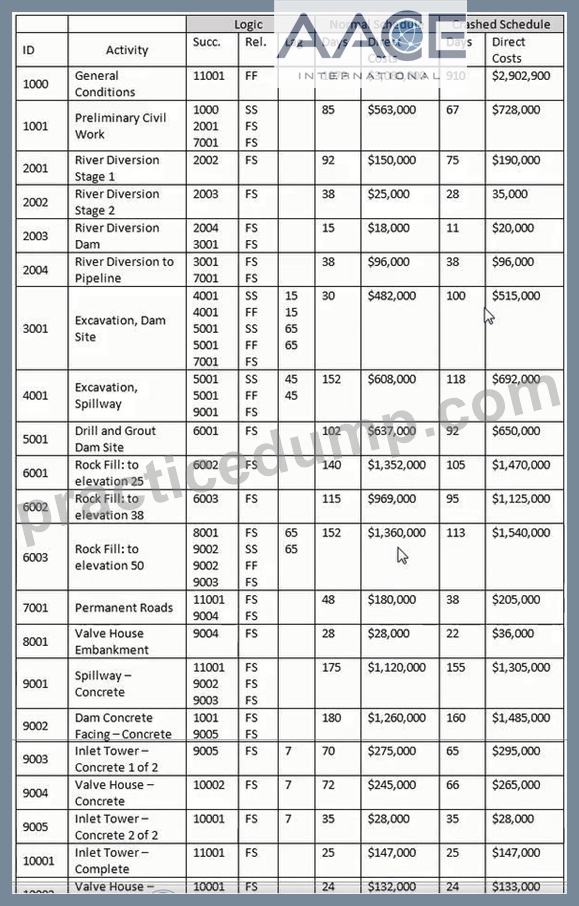
- A. 2003.
- B. 1000.
- C. 1001.
- D. 7001.
Answer: D
NEW QUESTION # 13
When are KPIs defined?
- A. At the start of the Construction Phase
- B. At project initiation
- C. After the Bidding Phase
- D. At NTP
Answer: B
NEW QUESTION # 14
What activities are concurrent to Activity 2001 in the "normal" schedule?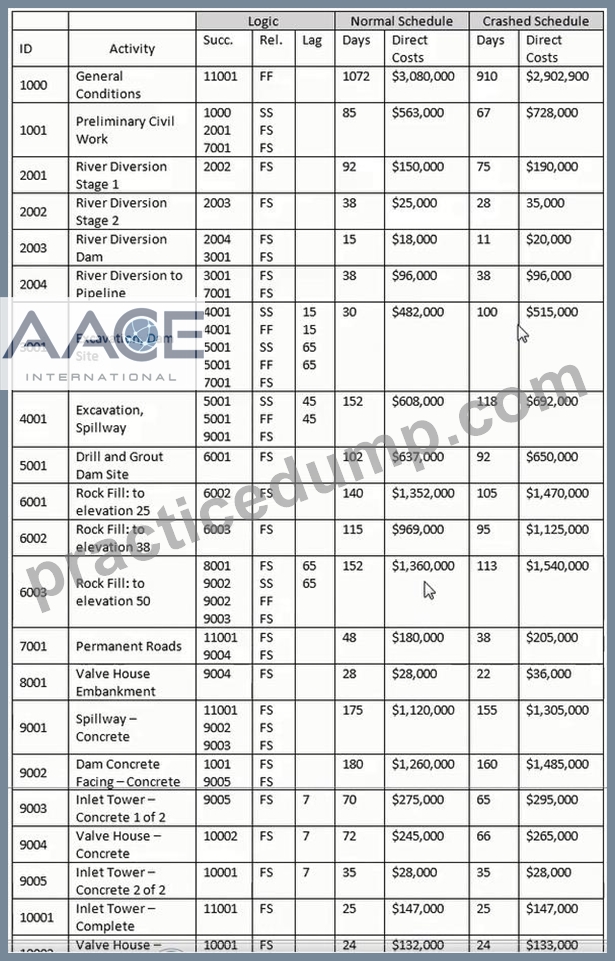
- A. 2003.
- B. 1000.
- C. 1001.
- D. 7001.
Answer: D
NEW QUESTION # 15
Using the "normal" schedule, theoretically construct a hammock for activities 6001-6003. What is the duration of the hammock?
- A. 267 days
- B. 255 days
- C. 362 days
- D. 407 days
Answer: D
NEW QUESTION # 16
Using the normal schedule, what is the early finish date and total float of Activity 10002?
- A. 24 Dec 2023. and 24 days of tree float
- B. 24 Nov 2023. and 24 days of tree float
- C. 21 Dec 2023. and 4 days of total float
- D. 17 Dec 2023. and 4 days of total float
Answer: C
Explanation:
The early finish date and total float are determined using CPM calculations. The PSP Study Guide outlines that early finish is calculated as the early start date plus activity duration, adjusted for calendar constraints (PSP Study Guide, Subchapter 2.2.5, "Constraints and Calendars").
Steps:
Determine early start using forward pass calculations.
Add the activity duration.
Consider non-working days or holidays as per the project calendar.
Calculate float as the difference between late start and early start or late finish and early finish.
NEW QUESTION # 17
In analyzing a logical chain of activities in a critical path method (CPM) schedule, what do differing total float values within that chain typically indicate?
- A. Certain activities in the critical path have no successors.
- B. The schedule has too much detail to reflect an accurate critical path.
- C. The schedule is projecting an "early completion".
- D. Different calendars are assigned to certain activities in the logical chain.
Answer: D
Explanation:
* Impact of Calendars on Total Float:
Differing calendars (e.g., working days, holidays, or shifts) assigned to activities can result in varying total float values within a logical chain.
Total float measures the flexibility of an activity and is calculated based on its calendar and logical dependencies.
* PSP Study Guide Reference:
The guide covers how calendar assignments influence float calculations and their potential to create disparities in a critical path.
* Conclusion: The correct answer is B, as differing total float values typically indicate the use of different calendars for activities in the chain.
NEW QUESTION # 18
You are developing a detailed critical path schedule for a proposed petrochemical plant. The schedule will become a part of the project baseline document, which will be sent to the company's board of directors for its consideration. What document or resource is likely to be MOST valuable in determining the schedule's work activity durations?
- A. The Petrochemical Industry New Plant Task Duration Handbook.
- B. The cost estimate for the plant prepared by your firm's estimating department.
- C. Critical path schedules prepared by you for similar completed projects.
- D. Industry publications.
Answer: C
NEW QUESTION # 19
Activity durations are normally estimated in an intuitive and subjective way. All of the following will improve duration accuracy EXCEPT
- A. Divide activities into smaller activities. This will increase activity detail and duration estimate accuracy.
- B. Use gross building square footages. The pluses and minuses all average out.
- C. Use the people responsible for performing the work as a resource to assign activity durations.
- D. Look at each activity independently and don't follow specific logic paths when assigning activity durations.
Answer: B
NEW QUESTION # 20
Which of the following is NOT required when performing weekly or monthly schedule updates?
- A. Original duration of activities.
- B. Percent complete.
- C. Remaining duration of activities.
- D. Actual finish of activities.
Answer: C
NEW QUESTION # 21
Which of the following is not an internal stakeholder?
- A. installer
- B. Subcontractor
- C. Prime Contractor
- D. Owner
Answer: D
NEW QUESTION # 22
An earned value-based project control system can use either of which two budgets as the basis of its calculations?
- A. Labor hours or dollars.
- B. Earned or budgeted cost yearly.
- C. Linear feet or dollars.
- D. Direct or indirect cost.
Answer: A
Explanation:
An earned value management (EVM) system can base its calculations on labor hours or monetary values, depending on the nature of the project. Both methods are valid for tracking performance and forecasting outcomes.
Option B (direct or indirect cost) does not align with EVM's focus on performance metrics.
Option C confuses timeframes with budgeting principles.
Option D (linear feet or dollars) applies to physical progress tracking but not directly to EVM systems.
This is consistent with EVM principles as outlined in project control methodologies within the PSP materials.
NEW QUESTION # 23
As a change to the network for the current update, activity 6002 is required to begin ten days after the beginning of activity 6001. Which is the simplest logic organization?
- A. A start-to-start to relationship for both activities 6001 and 6002 with a ten-day lag assigned to activity 6002.
- B. A start-to-finish relationship with both activities 6001 and 6002 having a ten-day lag
- C. A finish-to-start relationship with a ten-day lag assigned to activity 6002; activity 6001 will be dependent on activity 6002
- D. A start-to-start relationship with a ten-day lag assigned to activity 6001; activity 6002 will be dependent on activity 6001
Answer: D
NEW QUESTION # 24
A good change management plan___________.
- A. tracks minor decisions
- B. is detailed during the planning phase
- C. involves only the project controls team
- D. is provided to stakeholders after it is created
Answer: B
NEW QUESTION # 25
What problems can a soils engineer deal with on a project?
- A. Hidden subsurface conditions.
- B. Survey error.
- C. Toxic soils.
- D. Archeological findings.
Answer: A
NEW QUESTION # 26
Prior to the beginning work on Activity 6001, the scope is changed by executed change order to increase the activity duration by thirty days and rock fill by 100.000 cubic meters If the project has progressed as scheduled up to the point of the executed change order, what activities would be changed on the next project update?
- A. 1001 and 6001
- B. 1000. 1001. and 6001
- C. 9001 and 6002 and 6002
- D. 1000 and 6001
Answer: C
NEW QUESTION # 27
How much Total Float does drafting the product manual have?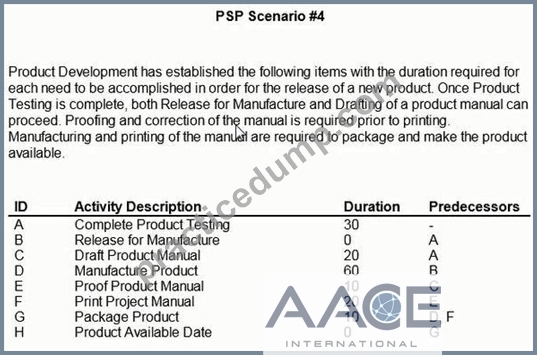
- A. 10 workdays.
- B. 0 workdays.
- C. 5 workdays.
- D. 15 workdays.
Answer: A
NEW QUESTION # 28
Management has determined the need to release the product 20 days earlier than planned. What tasks need to be expedited?
- A. Drafting and Proofing the Manual.
- B. Testing, Manufacturing and Packaging.
- C. Packaging only.
- D. Printing the Manual.
Answer: B
NEW QUESTION # 29
What day would Activity C complete if the duration of Activity A was reduced by five days?
- A. 0
- B. 1
- C. 2
- D. 3
Answer: D
Explanation:
To calculate the completion day for Activity C:
Reduce Activity A's duration by five days.
Recalculate dependent activities' start and finish times using forward pass logic (PSP Study Guide, Subchapter 2.2.4, "Relationships").
Sum up the adjusted durations to determine the completion day for Activity C.
This aligns with the logic of schedule adjustments and dependencies as outlined in the PSP Study Guide.
NEW QUESTION # 30
Determine the correct formula and date for the late finish for Activity 2001.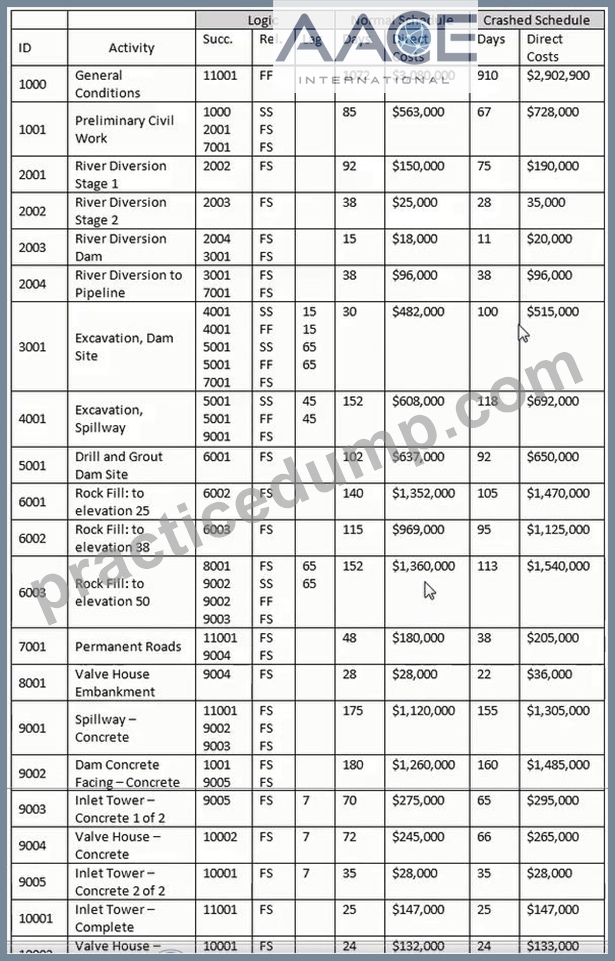
- A. LS.2002- 1 day-> 08-29-01.
- B. LS.2002 + 1 day -> 08-30-01.
- C. LS.2002 - 1 day -> 08-28-01.
- D. LF.2001 - 1 day -> 08-28-01.
Answer: A
Explanation:
* Activity Details (2001 - "River Diversion Stage 1"):
Successor: 2002 ("River Diversion Stage 2").
Relationship: Finish-to-Start (FS) with no lag.
Normal schedule duration for Activity 2001 = 92 days.
* Backward Pass Calculation for Late Finish (LF):
The Late Finish (LF) of Activity 2001 is derived from the Late Start (LS) of its successor, Activity 2002.
Formula: LF.2001 = LS.2002 - 1 day.
* Date Calculation:
Given: LS.2002 = 08-30-01 (as per data in the schedule).
LF.2001 = LS.2002 - 1 day = 08-30-01 - 1 day = 08-29-01.
* Cross-Verification with Answer Options:
Option A: Incorrect. Misrepresents the Late Finish formula.
Option C: Incorrect. Adds 1 day instead of subtracting.
Option D: Incorrect. Incorrect date application.
Option B: Correct. Matches both formula and calculation.
NEW QUESTION # 31
......
AACE International is a professional association that serves the cost and management community worldwide. The association offers a variety of certifications, including the Planning & Scheduling Professional (PSP) Certification Exam. The PSP certification is designed to recognize professionals who have demonstrated expertise in the planning and scheduling of projects, as well as the ability to analyze and evaluate project performance.
Tested Material Used To AACE-PSP Test Engine: https://pass4sure.practicedump.com/AACE-PSP-exam-questions.html