

PracticeDump Databricks-Certified-Professional-Data-Engineer Dumps Real Exam Questions Test Engine Dumps Training
Databricks Databricks-Certified-Professional-Data-Engineer exam dumps and online Test Engine
NEW QUESTION # 13
What is the output of below function when executed with input parameters 1, 3 :
1.def check_input(x,y):
2. if x < y:
3. x= x+1
4. if x>y:
5. x= x+1
6. if x <y:
7. x = x+1
8. return x
- A. 0
- B. 1
- C. 2
- D. 3
- E. 4
Answer: C
NEW QUESTION # 14
A junior developer complains that the code in their notebook isn't producing the correct results in the development environment. A shared screenshot reveals that while they're using a notebook versioned with Databricks Repos, they're using a personal branch that contains old logic. The desired branch named dev-2.3.9 is not available from the branch selection dropdown.
Which approach will allow this developer to review the current logic for this notebook?
- A. Use Repos to make a pull request use the Databricks REST API to update the current branch to dev-2.3.9
- B. Use Repos to merge the current branch and the dev-2.3.9 branch, then make a pull request to sync with the remote repository
- C. Merge all changes back to the main branch in the remote Git repository and clone the repo again
- D. Use Repos to pull changes from the remote Git repository and select the dev-2.3.9 branch.
- E. Use Repos to checkout the dev-2.3.9 branch and auto-resolve conflicts with the current branch
Answer: D
Explanation:
This is the correct answer because it will allow the developer to update their local repository with the latest changes from the remote repository and switch to the desired branch. Pulling changes will not affect the current branch or create any conflicts, as it will only fetch the changes and not merge them. Selecting the dev-2.3.9 branch from the dropdown will checkout that branch and display its contents in the notebook. Verified Reference: [Databricks Certified Data Engineer Professional], under "Databricks Tooling" section; Databricks Documentation, under "Pull changes from a remote repository" section.
NEW QUESTION # 15
A table named user_ltv is being used to create a view that will be used by data analysis on various teams.
Users in the workspace are configured into groups, which are used for setting up data access using ACLs.
The user_ltv table has the following schema:
An analyze who is not a member of the auditing group executing the following query:
Which result will be returned by this query?
- A. All age values less than 18 will be returned as null values all other columns will be returned with the values in user_ltv.
- B. All records from all columns will be displayed with the values in user_ltv.
- C. All columns will be displayed normally for those records that have an age greater than 18; records not meeting this condition will be omitted.
- D. All columns will be displayed normally for those records that have an age greater than 17; records not meeting this condition will be omitted.
Answer: C
Explanation:
Given the CASE statement in the view definition, the result set for a user not in the auditing group would be constrained by the ELSE condition, which filters out records based on age. Therefore, the view will return all columns normally for records with an age greater than 18, as users who are not in the auditing group will not satisfy the is_member('auditing') condition. Records not meeting the age > 18 condition will not be displayed.
NEW QUESTION # 16
A table named user_ltv is being used to create a view that will be used by data analysts on various teams.
Users in the workspace are configured into groups, which are used for setting up data access using ACLs.
The user_ltv table has the following schema:
email STRING, age INT, ltv INT
The following view definition is executed:
An analyst who is not a member of the marketing group executes the following query:
SELECT * FROM email_ltv
Which statement describes the results returned by this query?
- A. The email, age. and ltv columns will be returned with the values in user ltv.
- B. Only the email and ltv columns will be returned; the email column will contain the string
"REDACTED" in each row. - C. Only the email and itv columns will be returned; the email column will contain all null values.
- D. Three columns will be returned, but one column will be named "redacted" and contain only null values.
- E. The email and ltv columns will be returned with the values in user itv.
Answer: B
Explanation:
The code creates a view called email_ltv that selects the email and ltv columns from a table called user_ltv, which has the following schema: email STRING, age INT, ltv INT. The code also uses the CASE WHEN expression to replace the email values with the string "REDACTED" if the user is not a member of the marketing group. The user who executes the query is not a member of the marketing group, so they will only see the email and ltv columns, and the email column will contain the string "REDACTED" in each row.
Verified References: [Databricks Certified Data Engineer Professional], under "Lakehouse" section; Databricks Documentation, under "CASE expression" section.
NEW QUESTION # 17
The data analyst team had put together queries that identify items that are out of stock based on orders and replenishment but when they run all together for final output the team noticed it takes a really long time, you were asked to look at the reason why queries are running slow and identify steps to improve the performance and when you looked at it you noticed all the code queries are running sequentially and using a SQL endpoint cluster. Which of the following steps can be taken to resolve the issue?
Here is the example query
1.--- Get order summary
2.create or replace table orders_summary
3.as
4.select product_id, sum(order_count) order_count
5.from
6. (
7. select product_id,order_count from orders_instore
8. union all
9. select product_id,order_count from orders_online
10. )
11.group by product_id
12.-- get supply summary
13.create or repalce tabe supply_summary
14.as
15.select product_id, sum(supply_count) supply_count
16.from supply
17.group by product_id
18.
19.-- get on hand based on orders summary and supply summary
20.
21.with stock_cte
22.as (
23.select nvl(s.product_id,o.product_id) as product_id,
24. nvl(supply_count,0) - nvl(order_count,0) as on_hand
25.from supply_summary s
26.full outer join orders_summary o
27. on s.product_id = o.product_id
28.)
29.select *
30.from
31.stock_cte
32.where on_hand = 0
- A. Increase the cluster size of the SQL endpoint.
- B. Increase the maximum bound of the SQL endpoint's scaling range.
- C. Turn on the Serverless feature for the SQL endpoint.
- D. Turn on the Serverless feature for the SQL endpoint and change the Spot Instance Pol-icy to "Reliability Optimized."
- E. Turn on the Auto Stop feature for the SQL endpoint.
Answer: A
Explanation:
Explanation
The answer is to increase the cluster size of the SQL Endpoint, here queries are running sequentially and since the single query can not span more than one cluster adding more clusters won't improve the query but rather increasing the cluster size will improve performance so it can use additional compute in a warehouse.
In the exam please note that additional context will not be given instead you have to look for cue words or need to understand if the queries are running sequentially or concurrently. if the que-ries are running sequentially then scale up(more nodes) if the queries are running concurrently (more users) then scale out(more clusters).
Below is the snippet from Azure, as you can see by increasing the cluster size you are able to add more worker nodes.
SQL endpoint scales horizontally(scale-out) and vertically (scale-up), you have to understand when to use what.
Scale-up-> Increase the size of the cluster from x-small to small, to medium, X Large....
If you are trying to improve the performance of a single query having additional memory, additional nodes and cpu in the cluster will improve the performance.
Scale-out -> Add more clusters, change max number of clusters
If you are trying to improve the throughput, being able to run as many queries as possible then having an additional cluster(s) will improve the performance.
SQL endpoint
A picture containing diagram Description automatically generated
NEW QUESTION # 18
All records from an Apache Kafka producer are being ingested into a single Delta Lake table with the following schema:
key BINARY, value BINARY, topic STRING, partition LONG, offset LONG, timestamp LONG There are 5 unique topics being ingested. Only the "registration" topic contains Personal Identifiable Information (PII). The company wishes to restrict access to PII. The company also wishes to only retain records containing PII in this table for 14 days after initial ingestion. However, for non-PII information, it would like to retain these records indefinitely.
Which of the following solutions meets the requirements?
- A. All data should be deleted biweekly; Delta Lake's time travel functionality should be leveraged to maintain a history of non-PII information.
- B. Data should be partitioned by the topic field, allowing ACLs and delete statements to leverage partition boundaries.
- C. Data should be partitioned by the registration field, allowing ACLs and delete statements to be set for the PII directory.
- D. Because the value field is stored as binary data, this information is not considered PII and no special precautions should be taken.
- E. Separate object storage containers should be specified based on the partition field, allowing isolation at the storage level.
Answer: B
Explanation:
Partitioning the data by the topic field allows the company to apply different access control policies and retention policies for different topics. For example, the company can use the Table Access Control feature to grant or revoke permissions to the registration topic based on user roles or groups. The company can also use the DELETE command to remove records from the registration topic that are older than 14 days, while keeping the records from other topics indefinitely. Partitioning by the topic field also improves the performance of queries that filter by the topic field, as they can skip reading irrelevant partitions. References:
* Table Access Control: https://docs.databricks.com/security/access-control/table-acls/index.html
* DELETE: https://docs.databricks.com/delta/delta-update.html#delete-from-a-table
NEW QUESTION # 19
Which of the following is not a privilege in the Unity catalog?
- A. DELETE
- B. SELECT
- C. CREATE TABLE
- D. EXECUTE
- E. MODIFY
Answer: A
Explanation:
Explanation
The Answer is DELETE and UPDATE permissions do not exit, you have to use MODIFY which provides both Update and Delete permissions.
Please note: TABLE ACL privilege types are different from Unity Catalog privilege types, please read the question carefully.
Here is the list of all privileges in Unity Catalog:
Unity Catalog Privileges
https://learn.microsoft.com/en-us/azure/databricks/spark/latest/spark-sql/language-manual/sql-ref-privileges#priv Table ACL privileges
https://learn.microsoft.com/en-us/azure/databricks/security/access-control/table-acls/object-privileges#privileges
NEW QUESTION # 20
The data science team has requested assistance in accelerating queries on free form text from user reviews.
The data is currently stored in Parquet with the below schema:
item_id INT, user_id INT, review_id INT, rating FLOAT, review STRING
The review column contains the full text of the review left by the user. Specifically, the data science team is looking to identify if any of 30 key words exist in this field.
A junior data engineer suggests converting this data to Delta Lake will improve query performance.
Which response to the junior data engineer s suggestion is correct?
- A. ZORDER ON review will need to be run to see performance gains.
- B. Delta Lake statistics are only collected on the first 4 columns in a table.
- C. Delta Lake statistics are not optimized for free text fields with high cardinality.
- D. The Delta log creates a term matrix for free text fields to support selective filtering.
- E. Text data cannot be stored with Delta Lake.
Answer: C
Explanation:
Explanation
Converting the data to Delta Lake may not improve query performance on free text fields with high cardinality, such as the review column. This is because Delta Lakecollects statistics on the minimum and maximum values of each column, which are not very useful for filtering or skipping data on free text fields.
Moreover, Delta Lake collects statistics on the first 32 columns by default, which may not include the review column if the table has more columns. Therefore, the junior data engineer's suggestion is not correct. A better approach would be to use a full-text search engine, such as Elasticsearch, to index and query the review column. Alternatively, you can use natural language processing techniques, such as tokenization, stemming, and lemmatization, to preprocess the review column and create a new column with normalized terms that can be used for filtering or skipping data. References:
Optimizations: https://docs.delta.io/latest/optimizations-oss.html
Full-text search with Elasticsearch: https://docs.databricks.com/data/data-sources/elasticsearch.html Natural language processing: https://docs.databricks.com/applications/nlp/index.html
NEW QUESTION # 21
A Delta Lake table in the Lakehouse named customer_parsams is used in churn prediction by the machine learning team. The table contains information about customers derived from a number of upstream sources.
Currently, the data engineering team populates this table nightly by overwriting the table with the current valid values derived from upstream data sources.
Immediately after each update succeeds, the data engineer team would like to determine the difference between the new version and the previous of the table.
Given the current implementation, which method can be used?
- A. Parse the Spark event logs to identify those rows that were updated, inserted, or deleted.
- B. Execute a query to calculate the difference between the new version and the previous version using Delta Lake's built-in versioning and time travel functionality.
- C. Execute DESCRIBE HISTORY customer_churn_params to obtain the full operation metrics for the update, including a log of all records that have been added or modified.
- D. Parse the Delta Lake transaction log to identify all newly written data files.
Answer: B
Explanation:
Delta Lake provides built-in versioning and time travel capabilities, allowing users to query previous snapshots of a table. This feature is particularly useful for understanding changes between different versions of the table. In this scenario, where the table is overwritten nightly, you can use Delta Lake's time travel feature to execute a query comparing the latest version of the table (the current state) with its previous version. This approach effectively identifies the differences (such as new, updated, or deleted records) between the two versions. The other options do not provide a straightforward or efficient way to directly compare different versions of a Delta Lake table.
References:
* Delta Lake Documentation on Time Travel: Delta Time Travel
* Delta Lake Versioning: Delta Lake Versioning Guide
NEW QUESTION # 22
The downstream consumers of a Delta Lake table have been complaining about data quality issues impacting performance in their applications. Specifically, they have complained that invalid latitude and longitude values in the activity_details table have been breaking their ability to use other geolocation processes.
A junior engineer has written the following code to add CHECK constraints to the Delta Lake table:
A senior engineer has confirmed the above logic is correct and the valid ranges for latitude and longitude are provided, but the code fails when executed.
Which statement explains the cause of this failure?
- A. The activity details table already exists; CHECK constraints can only be added during initial table creation.
- B. The activity details table already contains records that violate the constraints; all existing data must pass CHECK constraints in order to add them to an existing table.
- C. The activity details table already contains records; CHECK constraints can only be added prior to inserting values into a table.
- D. Because another team uses this table to support a frequently running application, two-phase locking is preventing the operation from committing.
- E. The current table schema does not contain the field valid coordinates; schema evolution will need to be enabled before altering the table to add a constraint.
Answer: B
Explanation:
The failure is that the code to add CHECK constraints to the Delta Lake table fails when executed. The code uses ALTER TABLE ADD CONSTRAINT commands to add two CHECK constraints to a table named activity_details. The first constraint checks if the latitude value is between -90 and 90, and the second constraint checks if the longitude value is between -180 and 180. The cause of this failure is that the activity_details table already contains records that violate these constraints, meaning that they have invalid latitude or longitude values outside of these ranges. When adding CHECK constraints to an existing table, Delta Lake verifies that all existing data satisfies the constraints before adding them to the table. If any record violates the constraints, Delta Lake throws an exception and aborts the operation. Verified Reference: [Databricks Certified Data Engineer Professional], under "Delta Lake" section; Databricks Documentation, under "Add a CHECK constraint to an existing table" section.
https://docs.databricks.com/en/sql/language-manual/sql-ref-syntax-ddl-alter-table.html#add-constraint
NEW QUESTION # 23
An upstream source writes Parquet data as hourly batches to directories named with the current date. A nightly batch job runs the following code to ingest all data from the previous day as indicated by the date variable: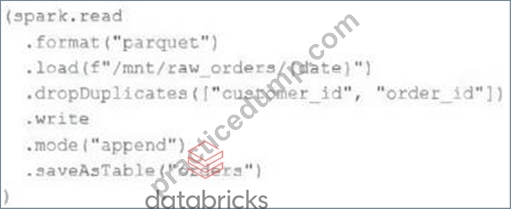
Assume that the fields customer_id and order_id serve as a composite key to uniquely identify each order.
If the upstream system is known to occasionally produce duplicate entries for a single order hours apart, which statement is correct?
- A. Each write to the orders table will only contain unique records; if existing records with the same key are present in the target table, these records will be overwritten.
- B. Each write to the orders table will only contain unique records, and only those records without duplicates in the target table will be written.
- C. Each write to the orders table will run deduplication over the union of new and existing records, ensuring no duplicate records are present.
- D. Each write to the orders table will only contain unique records, but newly written records may have duplicates already present in the target table.
- E. Each write to the orders table will only contain unique records; if existing records with the same key are present in the target table, the operation will tail.
Answer: D
Explanation:
This is the correct answer because the code uses the dropDuplicates method to remove any duplicate records within each batch of data before writing to the orders table. However, this method does not check for duplicates across different batches or in the target table, so it is possible that newly written records may have duplicates already present in the target table. To avoid this, a better approach would be to use Delta Lake and perform an upsert operation using mergeInto. Verified Reference: [Databricks Certified Data Engineer Professional], under "Delta Lake" section; Databricks Documentation, under "DROP DUPLICATES" section.
NEW QUESTION # 24
You are currently working with the application team to setup a SQL Endpoint point, once the team started consuming the SQL Endpoint you noticed that during peak hours as the number of concur-rent users increases you are seeing degradation in the query performance and the same queries are taking longer to run, which of the following steps can be taken to resolve the issue?
- A. They can increase the cluster size(2X-Small to 4X-Large) of the SQL endpoint.
- B. They can increase the maximum bound of the SQL endpoint's scaling range.
- C. They can turn on the Auto Stop feature for the SQL endpoint.
- D. They can turn on the Serverless feature for the SQL endpoint.
- E. They can turn on the Serverless feature for the SQL endpoint and change the Spot In-stance Policy from
"Cost optimized" to "Reliability Optimized."
Answer: B
Explanation:
Explanation
The answer is, They can increase the maximum bound of the SQL endpoint's scaling range, when you increase the max scaling range more clusters are added so queries instead of waiting in the queue can start running using available clusters, see below for more explanation.
The question is looking to test your ability to know how to scale a SQL Endpoint(SQL Warehouse) and you have to look for cue words or need to understand if the queries are running sequentially or concurrently. if the queries are running sequentially then scale up(Size of the cluster from 2X-Small to 4X-Large) if the queries are running concurrently or with more users then scale out(add more clusters).
SQL Endpoint(SQL Warehouse) Overview: (Please read all of the below points and the below diagram to understand )
1.A SQL Warehouse should have at least one cluster
2.A cluster comprises one driver node and one or many worker nodes
3.No of worker nodes in a cluster is determined by the size of the cluster (2X -Small ->1 worker, X-Small ->2 workers.... up to 4X-Large -> 128 workers) this is called Scale up
4.A single cluster irrespective of cluster size(2X-Smal.. to ...4XLarge) can only run 10 queries at any given time if a user submits 20 queries all at once to a warehouse with 3X-Large cluster size and cluster scaling (min
1, max1) while 10 queries will start running the remaining 10 queries wait in a queue for these 10 to finish.
5.Increasing the Warehouse cluster size can improve the performance of a query, example if a query runs for 1 minute in a 2X-Small warehouse size, it may run in 30 Seconds if we change the warehouse size to X-Small.
this is due to 2X-Small has 1 worker node and X-Small has 2 worker nodes so the query has more tasks and runs faster (note: this is an ideal case example, the scalability of a query performance depends on many factors, it can not always be linear)
6.A warehouse can have more than one cluster this is called Scale out. If a warehouse is con-figured with X-Small cluster size with cluster scaling(Min1, Max 2) Databricks spins up an additional cluster if it detects queries are waiting in the queue, If a warehouse is configured to run 2 clusters(Min1, Max 2), and let's say a user submits 20 queries, 10 queriers will start running and holds the remaining in the queue and databricks will automatically start the second cluster and starts redirecting the 10 queries waiting in the queue to the second cluster.
7.A single query will not span more than one cluster, once a query is submitted to a cluster it will remain in that cluster until the query execution finishes irrespective of how many clusters are available to scale.
Please review the below diagram to understand the above concepts:
Box and whisker chart Description automatically generated
SQL endpoint(SQL Warehouse) scales horizontally(scale-out) and vertical (scale-up), you have to understand when to use what.
Scale-out -> to add more clusters for a SQL endpoint, change max number of clusters If you are trying to improve the throughput, being able to run as many queries as possible then having an additional cluster(s) will improve the performance.
Databricks SQL automatically scales as soon as it detects queries are in queuing state, in this example scaling is set for min 1 and max 3 which means the warehouse can add three clusters if it detects queries are waiting.
Diagram Description automatically generated
During the warehouse creation or after you have the ability to change the warehouse size (2X-Small....to
...4XLarge) to improve query performance and the maximize scaling range to add more clusters on a SQL Endpoint(SQL Warehouse) scale-out, if you are changing an existing warehouse you may have to restart the warehouse to make the changes effective.
A picture containing diagram Description automatically generated
NEW QUESTION # 25
The Databricks CLI is use to trigger a run of an existing job by passing the job_id parameter. The response that the job run request has been submitted successfully includes a filed run_id.
Which statement describes what the number alongside this field represents?
- A. The number of times the job definition has been run in the workspace.
- B. The globally unique ID of the newly triggered run.
- C. The job_id and number of times the job has been are concatenated and returned.
- D. The job_id is returned in this field.
Answer: B
Explanation:
When triggering a job run using the Databricks CLI, the run_id field in the response represents a globally unique identifier for that particular run of the job. This run_id is distinct from the job_id. While the job_id identifies the job definition and is constant across all runs of that job, the run_id is unique to each execution and is used to track and query the status of that specific job run within the Databricks environment. This distinction allows users to manage and reference individual executions of a job directly.
NEW QUESTION # 26
What are the advantages of the Hashing Features?
- A. Requires the less memory
- B. Easily reverse engineer vectors to determine which original feature mapped to a vector location
- C. Less pass through the training data
Answer: A,C
Explanation:
Explanation
SGD-based classifiers avoid the need to predetermine vector size by simply picking a reasonable size and
shoehorning the training data into vectors of that size. This approach is known as feature hashing. The
shoehorning is done by picking one or more locations by using a hash of the name of the variable for
continuous variables or a hash of the variable name and the category name or word for categorical, text*like, or
word-like data.
This hashed feature approach has the distinct advantage of requiring less memory and one less pass through
the training data, but it can make it much harder to reverse engineer vectors to determine which original
feature mapped to a vector location. This is because multiple features may hash to the same location. With
large vectors or with multiple locations per feature, this isn't a problem for accuracy but it can make it hard to
understand what a classifier is doing.
An additional benefit of feature hashing is that the unknown and unbounded vocabularies typical of word-like
variables aren't a problem.
NEW QUESTION # 27
You have noticed the Data scientist team is using the notebook versioning feature with git integra-tion, you have recommended them to switch to using Databricks Repos, which of the below reasons could be the reason the why the team needs to switch to Databricks Repos.
- A. Databricks Repos automatically saves changes
- B. Databricks Repos allow you to add comments and select the changes you want to commit.
- C. Databricks Repos has a built-in version control system
- D. Databricks Repos allows merge and conflict resolution
- E. Databricks Repos allows multiple users to make changes
Answer: B
Explanation:
Explanation
The answer is Databricks Repos allow you to add comments and select the changes you want to commit.
NEW QUESTION # 28
Data science team members are using a single cluster to perform data analysis, although cluster size was chosen to handle multiple users and auto-scaling was enabled, the team realized queries are still running slow, what would be the suggested fix for this?
- A. Use High concurrency mode instead of the standard mode
- B. Disable the auto-scaling feature
- C. Increase the size of the driver node
- D. Setup multiple clusters so each team member has their own cluster
Answer: A
Explanation:
Explanation
The answer is Use High concurrency mode instead of the standard mode,
https://docs.databricks.com/clusters/cluster-config-best-practices.html#cluster-mode High Concurrency clusters are ideal for groups of users who need to share resources or run ad-hoc jobs.
Databricks recommends enabling autoscaling for High Concurrency clusters.
NEW QUESTION # 29
Which of the following describes a scenario in which a data engineer will want to use a Job cluster instead of
an all-purpose cluster?
- A. A data team needs to collaborate on the development of a machine learning model
- B. A data engineer needs to manually investigate a production error
- C. An automated workflow needs to be run every 30 minutes
- D. An ad-hoc analytics report needs to be developed while minimizing compute costs
- E. A Databricks SQL query needs to be scheduled for upward reporting
Answer: C
NEW QUESTION # 30
A data architect has heard about lake's built-in versioning and time travel capabilities. For auditing purposes they have a requirement to maintain a full of all valid street addresses as they appear in the customers table.
The architect is interested in implementing a Type 1 table, overwriting existing records with new values and relying on Delta Lake time travel to support long-term auditing. A data engineer on the project feels that a Type 2 table will provide better performance and scalability.
Which piece of information is critical to this decision?
- A. Shallow clones can be combined with Type 1 tables to accelerate historic queries for long-term versioning.
- B. Delta Lake time travel cannot be used to query previous versions of these tables because Type 1 changes modify data files in place.
- C. Delta Lake time travel does not scale well in cost or latency to provide a long-term versioning solution.
- D. Data corruption can occur if a query fails in a partially completed state because Type 2 tables requires
Answer: C
Explanation:
Setting multiple fields in a single update.
Explanation:
Delta Lake's time travel feature allows users to access previous versions of a table, providing a powerful tool for auditing and versioning. However, using time travel as a long-term versioning solution for auditing purposes can be less optimal in terms of cost and performance, especially as the volume of data and the number of versions grow. For maintaining a full history of valid street addresses as they appear in a customers table, using a Type 2 table (where each update creates a new record with versioning) might provide better scalability and performance by avoiding the overhead associated with accessing older versions of a large table. While Type 1 tables, where existing records are overwritten with new values, seem simpler and can leverage time travel for auditing, the critical piece of information is that time travel might not scale well in cost or latency for long-term versioning needs, making a Type 2 approach more viable for performance and scalability.
Reference:
Databricks Documentation on Delta Lake's Time Travel: Delta Lake Time Travel Databricks Blog on Managing Slowly Changing Dimensions in Delta Lake: Managing SCDs in Delta Lake
NEW QUESTION # 31
Which statement characterizes the general programming model used by Spark Structured Streaming?
- A. Structured Streaming is implemented as a messaging bus and is derived from Apache Kafka.
- B. Structured Streaming uses specialized hardware and I/O streams to achieve sub-second latency for data transfer.
- C. Structured Streaming leverages the parallel processing of GPUs to achieve highly parallel data throughput.
- D. Structured Streaming relies on a distributed network of nodes that hold incremental state values for cached stages.
- E. Structured Streaming models new data arriving in a data stream as new rows appended to an unbounded table.
Answer: E
Explanation:
Explanation
This is the correct answer because it characterizes the general programming model used by Spark Structured Streaming, which is to treat a live data stream as a table that is being continuously appended. This leads to a new stream processing model that is very similar to a batch processing model, where users can express their streaming computation using the same Dataset/DataFrame API as they would use for static data. The Spark SQL engine will take care of running the streaming query incrementally and continuously and updating the final result as streaming data continues to arrive. Verified References: [Databricks Certified Data Engineer Professional], under "Structured Streaming" section; Databricks Documentation, under "Overview" section.
NEW QUESTION # 32
......
Databricks Databricks-Certified-Professional-Data-Engineer: Selling Databricks Certification Products and Solutions: https://pass4sure.practicedump.com/Databricks-Certified-Professional-Data-Engineer-exam-questions.html