

Try Free and Start Using Realistic Verified CPC Dumps Instantly
CPC Actual Questions - Instant Download 197 Questions
AAPC CPC Exam Syllabus Topics:
| Topic | Details |
|---|---|
| Topic 1 |
|
| Topic 2 |
|
| Topic 3 |
|
| Topic 4 |
|
NEW QUESTION # 96
The gastroenterologist performs a simple excision of three external hemorrhoids and one internal hemorrhoid, each lying along the left lateral column. The operative report indicates that the internal hemorrhoid is not prolapsed and is outside of the anal canal.
What CPT and ICD-10CM codes are reported?
- A. 46255, K64.0, K64.4
- B. 46250, 46945, K64.0, K64.4
- C. 46250, K64.0, K64.9
- D. 46320, 46945, K64.0, K64.9
Answer: A
Explanation:
CPT code 46255 describes the excision of both internal and external hemorrhoids, which matches the procedure described. The ICD-10-CM codes K64.0 (First degree hemorrhoids) and K64.4 (Residual hemorrhoids) describe the conditions treated.
References:
* AMA's CPT Professional Edition (current year), Code 46255
* ICD-10-CM (current year), Codes K64.0, K64.4
NEW QUESTION # 97
Miranda is in her provider's office for follow up of her diabetes. Her blood sugars remain at goal with continuing her prescribed medications.
When referring to the MDM Table in the CPTcode book for number and complexity of problems addressed at the encounter, what type of problem is this considered?
- A. Stable, chronic illness
- B. Acute, uncomplicated illness or injury
- C. Stable, acute illness
- D. Minimal problem
Answer: A
Explanation:
1. Problem Type Selection:
Miranda is following up on her diabetes, which is a chronic condition. Her blood sugars are controlled, indicating that the condition is stable with her current medication regimen.
Stable, chronic illness is defined in the CPTMDM (Medical Decision Making) Table as a chronic condition that is under control and not currently worsening, even if ongoing management is required. This aligns with the patient's diabetes being well-managed with her prescribed medications.
2. Rationale for Excluding Other Options:
A: Acute, uncomplicated illness or injury is not applicable as diabetes is a chronic condition, not an acute issue.
B: Minimal problem refers to conditions that are minor or self-limited and typically require little to no treatment, which does not apply to chronic conditions like diabetes.
D: Stable, acute illness would refer to an acute condition that has stabilized, whereas diabetes is a chronic condition, not acute.
3. AAPC and CPTCoding Guidelines:
According to the CPTMDM Table, a "Stable, chronic illness" is the correct classification for a follow-up encounter on a controlled chronic condition like diabetes.
Therefore, the correct answer is C. Stable, chronic illness.
NEW QUESTION # 98
What is the muscular ring around a lumen that contracts to control flow through that lumen called?
- A. Sinus
- B. Snare
- C. Sphincter
- D. Stricture
Answer: C
Explanation:
A sphincter is a muscular ring that encircles a lumen (or passage) and contracts to control the flow of substances through it. Sphincters are found throughout the body in areas such as the gastrointestinal tract (e.g., the lower esophageal sphincter, pyloric sphincter, anal sphincter) and the urinary system (e.g., urethral sphincter), where they regulate the passage of food, waste, and other materials.
A: Stricture refers to an abnormal narrowing of a passage or duct in the body, often due to scarring or disease, not a muscular ring.
B: Snare is a surgical instrument, not a structure within the body.
D: Sinus refers to a cavity or channel within bone or tissue, unrelated to muscle control of flow.
Therefore, the correct answer is C. Sphincter.
NEW QUESTION # 99
A 43-year-old female with a history of joint pain and fatigue presents to the office with swollen salivary glands. Patient agrees to have a labial gland biopsy performed in office. Patient is numbed with a local anesthetic. Then an incision is made on the lower labial mucosa and tissue samples from the salivary gland are removed with tweezers. The incision is sutured. Pathology report findings are consistent with Sjogren's syndrome.
What CPTcode is reported?
- A. 0
- B. 1
- C. 2
- D. 3
Answer: A
Explanation:
1. Procedure and CPTCode Selection:
The scenario describes a labial gland biopsy of the salivary gland, performed in the office with a local anesthetic. The provider made an incision in the lower labial mucosa and took tissue samples from the salivary gland for biopsy.
Code 42400 is the correct CPTcode for a biopsy of a salivary gland. This code is specific to a biopsy without a more extensive excision or major surgery, aligning perfectly with the scenario of sampling salivary gland tissue.
2. Ruling Out Other Options:
Code 42408 is for the excision of a deep lobe of a parotid gland, which is a more extensive procedure than a simple biopsy and does not apply to this case.
Code 42405 is for the removal of an entire submandibular gland, which is a full excision and not applicable here.
Code 42450 is used for the removal of a sublingual gland, not for a biopsy of the labial salivary gland.
3. AAPC and CPTCoding Guidelines:
AAPC and CPTguidelines direct coders to use 42400 for minor biopsies of salivary gland tissue, particularly when only tissue samples are taken for diagnostic purposes, as described in this case.
Based on CPTcoding guidelines, the correct answer is C. 42400.
NEW QUESTION # 100
A 5-year-old who has an allergy history experienced a possible reaction to peanuts. A quantitative, high-sensitive fluorescent enzyme immunoassay was used to measure specific IgE for recombinant peanut components. Results showed there was no reaction indicating the child has a peanut allergy.
What lab test is reported?
- A. 0
- B. 1
- C. 2
- D. 3
Answer: C
Explanation:
For the quantitative, high-sensitive fluorescent enzyme immunoassay used to measure specific IgE for recombinant peanut components, the correct lab test code is 86003. This code is specific to quantitative allergen-specific IgE testing.
References:
* AMA's CPT Professional Edition (current year)
NEW QUESTION # 101
A patient has a bone infection being treated with vancomycin. A therapeutic drug assay is performed to measure the concentration of vancomycin in the patient's blood.
What lab test is reported?
- A. 0
- B. 1
- C. 2
- D. 3
Answer: A
Explanation:
1. Procedure and CPTCode Selection:
The test performed is a therapeutic drug assay to measure the concentration of vancomycin in the patient's blood.
CPTCode 80184 is specific for a therapeutic drug assay of vancomycin, making it the correct code to report for this test.
2. Rationale for Excluding Other Options:
Code 80197 is used for therapeutic drug assays of another antibiotic, gentamicin, and does not apply to vancomycin.
Code 80202 is for measuring the levels of cyclosporine, another drug, and is not relevant to vancomycin.
Code 80299 is for an unlisted therapeutic drug assay, which is unnecessary since a specific code (80184) exists for vancomycin.
3. AAPC and CPTCoding Guidelines:
According to AAPC guidelines, specific therapeutic drug assay codes, like 80184 for vancomycin, should be used when available.
Therefore, the correct answer is C. 80184.
NEW QUESTION # 102
The pulmonologist performs a bronchoscopy with fluoroscopic guidance. The scope is introduced into the right nostril and advanced to the vocal cords and into the trachea. The scope is advanced to the right upper lobe and a lung nodule is noted. An endobronchial biopsy is performed.
What CPT code is reported for the procedure?
- A. 0
- B. 1
- C. 2
- D. 3
Answer: B
NEW QUESTION # 103
Day 1 - A provider admits the patient to observation care for type 2 diabetes mellitus with hyperglycemia.
The provider orders a HbA1c, a urine (microalbumin), and kidney function lab tests.
Blood sugar is high and poorly controlled. The provider discusses the case with the patient's endocrinologist.
The provider prescribes an IV insulin drip, along with SQ insulin and keeps the patient in observation overnight.
Day 2 - Patient is in observation care and the provider orders a blood glucose test. The patient's glucose levels have improved. The provider places an order for the dietitian to see the patient.
Provider
documents spending a total time of 25 minutes with the patient.
Day 3 - Patient has a blood glucose test. The patient's glucose level is back to normal. The provider documents spending 15 minutes with the patient. The provider discharges the patient.
What E/M coding is reported by the physician for the patient in observation care?
- A. 99235, 99231, 99238
- B. 99222, 99231, 99238
- C. 99221, 99232, 99239
- D. 99235, 99238
Answer: A
Explanation:
For a patient in observation care, selecting the correct E/M codes requires evaluating each day's service level and the provider's documentation.
Day 1: The patient was admitted for observation, and the physician prescribed IV and SQ insulin, noting diabetes with hyperglycemia requiring complex management. The CPTcode 99235 is appropriate here because it represents an initial observation or inpatient care for patients with high-complexity medical decision-making (MDM), which aligns with the patient's unstable glucose and the management requirements.
Day 2: The patient's glucose levels improved, and the provider documented spending 25 minutes with the patient in continued observation care. Since this is an established patient with continued observation, 99231 applies here, indicating subsequent observation care with low MDM complexity.
Day 3: The provider documented spending 15 minutes with the patient, whose glucose levels normalized, and then discharged the patient from observation care. Code 99238 is used for a discharge from observation care and is selected based on discharge times under 30 minutes.
These codes were selected based on CPTguidelines for observation care and the provider's time-based documentation. This matches the medical decision complexity documented per the case and code descriptions available for observation care management.
NEW QUESTION # 104
View MR 005398
MR 005398
Operative Report
Preoperative Diagnosis: Nonfunctioning right kidney with ureteral stricture.
Postoperative Diagnosis: Nonfunctioning right kidney with ureteral stricture.
Procedure: Right nephrectomy with partial ureterectomy.
Findings and Procedure: Under satisfactory general anesthesia, the patient was placed in the right flank position. Right flank and abdomen were prepared and draped out of the sterile field. Skin incision was made between the 11th and 12th ribs laterally. The incision was carried down through the underlying subcutaneous tissues, muscles, and fascia. The right retroperitoneal space was entered. Using blunt and sharp dissection, the right kidney was freed circumferentially. The right artery, vein, and ureter were identified. The ureter was dissected downward where it is completely obstructed in its distal extent. The ureter was clipped and divided distally. The right renal artery was then isolated and divided between 0 silk suture ligatures. The right renal vein was also ligated with suture ligatures and 0 silk ties. The right kidney and ureter were then submitted for pathologic evaluation. The operative field was inspected, and there was no residual bleeding noted, and then it was carefully irrigated with sterile water. Wound closure was then undertaken using 0 Vicryl for the fascial layers, 0 Vicryl for the muscular layers, 2-0 chromic for subcutaneous tissue, and clips for the skin. A Penrose drain was brought out through the dependent aspect of the incision. The patient lost minimal blood and tolerated the procedure well.
What CPT coding is reported for this case?
- A. 0
- B. 1
- C. 2
- D. 3
Answer: A
Explanation:
The procedure involves a right nephrectomy with partial ureterectomy for a nonfunctioning right kidney with ureteral stricture.
* Procedure Description:
* Right nephrectomy (removal of the kidney).
* Partial ureterectomy (removal of part of the ureter).
* CPT Coding:
* 50220: Nephrectomy, including partial ureterectomy, any open approach.
References:
* AMA's CPT Professional Edition (current year).
* CPT Assistant for detailed coding guidelines on nephrectomy procedures.
NEW QUESTION # 105
A patient had surgery a year ago to repair two flexor tendons in his forearm. He is in surgery for a secondary repair for the same two tendons.
Which CPT coding is reported?
- A. 0
- B. 25263 x 2
- C. 1
- D. 25272 x 2
Answer: C
Explanation:
The scenario involves a secondary repair of two flexor tendons in the forearm. CPT code 25272 describes the repair of a secondary flexor tendon injury, including a graft, in the forearm and/or wrist, which fits the description provided. This code should be reported once, as the procedure encompasses the repair of multiple tendons.
References:
* AMA's CPT Professional Edition (current year), Code 25272
NEW QUESTION # 106
A patient presents to the office with dysuria and lower abdominal pain. The physician suspects she has a UTI.
A non-automated urinalysis is done in the office and is negative. UTI is ruled out for the final diagnosis.
What CPT and ICD-10-CM codes are reported?
- A. 81002, R30.0, R10.30
- B. 81000, N39.0
- C. 81002, N39.0
- D. 81000, R30.0, R10.30
Answer: A
Explanation:
1. Procedure and CPTCode Selection:
The urinalysis performed was non-automated and without microscopy.
CPTCode 81002 is appropriate for a non-automated urinalysis without microscopy. This code accurately reflects the test performed in the office.
2. Diagnosis and ICD-10-CM Code Selection:
ICD-10-CM Code R30.0 is used for dysuria, which was one of the patient's presenting symptoms.
ICD-10-CM Code R10.30 is used for lower abdominal pain, another presenting symptom.
Since the urinalysis ruled out a urinary tract infection, N39.0 (UTI) is not appropriate as a final diagnosis.
3. Rationale for Excluding Other Options:
Code 81000 (in options A and B) is for a urinalysis with microscopy, which was not performed here.
N39.0 is used when a UTI is confirmed, which is incorrect for this case since the urinalysis was negative, ruling out UTI.
4. AAPC and CPTCoding Guidelines:
AAPC guidelines recommend coding based on the symptoms when a specific diagnosis (such as UTI) is ruled out. Therefore, R30.0 and R10.30 are appropriate symptom codes for this encounter.
Thus, the correct answer is C. 81002, R30.0, R10.30.
NEW QUESTION # 107
A surgeon performed Mohs micrographic surgery on a lesion on the right arm. This required one stage with six tissue blocks.
What CPT@ codes are reported for the Mohs surgery?
- A. 85B2-335
- B. 17311, 17312, 17315
- C. 17313, 17315
- D. 17311, 17315
- E. 17313, 17314, 17315
Answer: D
Explanation:
For Mohs micrographic surgery, CPTcoding is based on the anatomic location of the lesion, the number of stages, and the number of tissue blocks per stage.
17311: This code is used for Mohs surgery on body areas such as the trunk, arms, or legs for the first stage.
17315: This is an add-on code used when more than five tissue blocks are examined in a single stage. Since this case involved six tissue blocks, 17315 is appropriate.
Explanation of incorrect answers:
A: 17313, 17314, 17315: Incorrect, as 17313 applies to the head, neck, hands, feet, or genitalia, not the arm.
C: 17313, 17315: Incorrect, as 17313 is not appropriate for the arm.
D: 17311, 17312, 17315: 17312 is used for additional stages beyond the first, which is not applicable here since only one stage was performed.
E: 85B2-335 is not a valid CPT code for Mohs surgery.
Thus, the correct answer is B. 17311, 17315, which accurately reflects a single-stage Mohs surgery with six tissue blocks on the arm.
NEW QUESTION # 108
A three-year-old patient is in the operative suite for stage 2 of treatment for double right outlet syndrome. The patient previously had the pulmonary artery banded and is returning for removal of the pulmonary band and transposition repair of the great vessels via aortic pulmonary reconstruction.
The surgeon performs a time-out and pre-incision review of respiration and BP then the previous sternal incision site is inspected and lightly painted with povidone. Next, reopens the sternal cavity and inserts central cannulae in the IVC, SVC and ascending aorta for extra corporeal membrane oxygenation (ECMO) bypass, chemical cardioplegia is initiated, stopping the heart and ECMO is initiated. A physician assistant monitors vitals and oxygenation until heart function resumes. The surgeon carefully incised and removes the Dacron band encircling the pulmonary artery, with nominal need for dilation. A section of coronary ostia is removed and sutured to the root of the pulmonary trunk. The pulmonary trunk and aortic root are then transected and transposed to allow for ideal cardiac circulation. Once structural integrity is visually confirmed, the physician assistant is permitted to administer the cardioplegia reversal solution and the surgeon removes the central cannulae after heart function safely resumes. The sternotomy is closed and the patient is transported to the NICU.
What CPTcodes are reported for the surgery today?
- A. 33778-58, 33955-58, 33985-58
- B. 33778-78, 33953-78, 33985-78
- C. 33779-78, 33953-78, 33985-78
- D. 33779-58, 33955-58, 33985-58
Answer: C
Explanation:
1. Procedure Details and CPTCode Selection:
The patient is undergoing stage 2 treatment for double outlet right ventricle (DORV) with a removal of the pulmonary artery band and transposition repair of the great vessels.
Code 33779 is specific for correction of a double outlet right ventricle, with transposition of the great arteries.
This code accurately reflects the procedure performed, including the complex repair involving the transposition of the pulmonary trunk and aortic root.
Code 33953 is used to report the initiation of extracorporeal membrane oxygenation (ECMO), which was used to maintain oxygenation during the procedure.
Code 33985 is for the termination of ECMO following the surgical repair once heart function has resumed.
Both 33953 and 33985 accurately document the initiation and termination of ECMO during this complex heart repair.
2. Modifier Selection:
Modifier 78 (unplanned return to the operating room for a related procedure during the postoperative period) is appropriate here. This is a subsequent stage in the treatment plan, but due to the complexity and specific surgical intervention required, it is treated as a return to the OR for related procedure coding.
Modifier 58 (staged or related procedure during the postoperative period) would not be as suitable here because the procedure involves a new return to the OR.
3. AAPC and CPTCoding Guidelines:
AAPC guidelines support the use of specific modifiers (78 for unplanned return) and appropriate ECMO codes (33953 and 33985) in complex cardiac cases requiring bypass and staged treatment.
Thus, the correct CPTcodes based on CPTand AAPC coding standards are C. 33779-78, 33953-78,
33985-78.
NEW QUESTION # 109
A patient with malignant lymphoma is administered the antineoplastic drug Rituximab 800 mg and then 100 mg of Benadryl.
Which HCPCS Level II codes are reported for both drugs administered intravenously?
- A. J9312 x 80, 00163 x 2
- B. J9312, J1200
- C. J9312, Q0163
- D. J9312 x 80, J1200 x 2
Answer: B
Explanation:
The patient with malignant lymphoma is administered Rituximab (800 mg) and Benadryl (100 mg) intravenously.
* Procedure Description:
* Administration of Rituximab (800 mg) intravenously.
* Administration of Benadryl (100 mg) intravenously.
* HCPCS Level II Coding:
* J9312: Injection, Rituximab, 10 mg.
* For 800 mg, report 80 units of J9312.
* J1200: Injection, Diphenhydramine HCl, up to 50 mg.
* For 100 mg, report 2 units of J1200.
References:
* HCPCS Level II Code Book (current year).
* HCPCS Level II coding guidelines for intravenous drug administration.
NEW QUESTION # 110 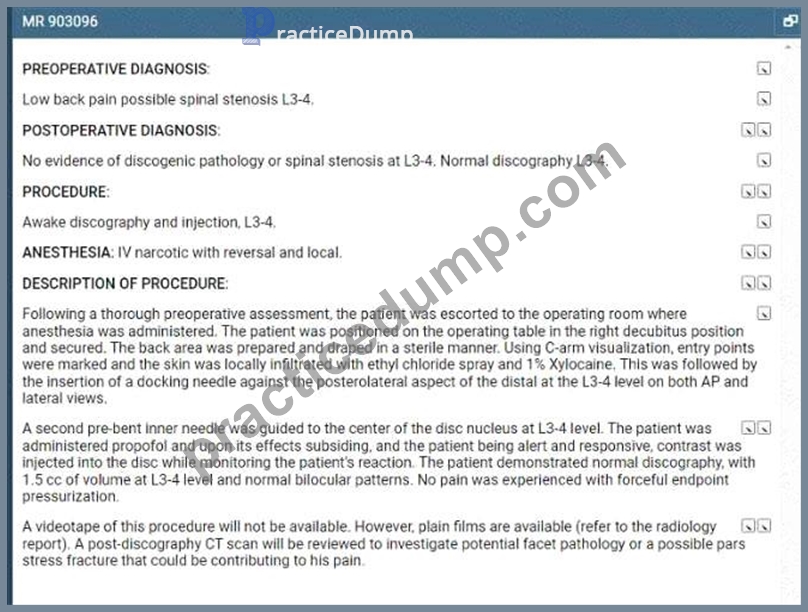
Refer to the supplemental information when answering this question:
View MR 903096
What CPTand ICD-10-CM coding is reported?
- A. 62290, M54.50
- B. 62292, M54.50
- C. 62292, M48.07, M54.50
- D. 62290, M48.061, M54.50
Answer: A
Explanation:
* CPT Code 62290: Discography, lumbar, single or multiple levels, radiological supervision and interpretation
* This code accurately describes the procedure performed. The documentation indicates a lumbar discography was performed at a single level (L3-4) with radiological supervision (C-arm visualization).
* ICD-10-CM Code M54.50: Low back pain, unspecified
* This code is the most appropriate diagnosis based on the documentation. The preoperative diagnosis states "Low back pain possible spinal stenosis L3-4." While spinal stenosis was considered, it was not confirmed. The postoperative diagnosis indicates no evidence of spinal stenosis or discogenic pathology. Therefore, the definitive diagnosis is low back pain.
Why other options are incorrect:
* 62292: This code is for a discography with injection of contrast and/or medication for therapeutic purposes. The documentation doesn't indicate any therapeutic injection was performed.
* M48.061 and M48.07: These codes represent spinal stenosis, which was not confirmed in the postoperative diagnosis.
References:
* CPT Code 62290: Discography, lumbar, single or multiple levels, radiological supervision and interpretation
* ICD-10-CM Code M54.50: Low back pain, unspecified
* AAPC Coder's Desk Reference: This resource provides detailed information on coding guidelines and procedures.
NEW QUESTION # 111
A 42-year-old with chronic left trochanteric bursitis is scheduled to receive an injection at the Pain Clinic. A 22-gauge spinal needle is introduced into the trochanteric bursa under ultrasonic guidance, and a total volume of 8 cc of normal saline and 40 mg of Kenalog was injected.
What CPT code should be reported for the surgical procedure?
- A. 20610-LT, 76942
- B. 20611-LT
- C. 20611-LT, 76942
- D. 20610-LT
Answer: B
NEW QUESTION # 112
A patient with multiple atypical lesions on the face and trunk is in the office to perform a biopsy. A punch tool was used to obtain a full-thickness tissue sample for two lesions on the trunk.
Partial-thickness tissue sample was taken from one lesion on the forehead using a curette.
What CPTcoding is reported?
- A. 11104 x 2, 11102
- B. 11104, 11103 x 2
- C. O11104, 11102 x 2
- D. 11104, 11105, 11103
Answer: A
Explanation:
The CPTcodes for skin biopsies depend on the method used and the location of each lesion. Here, the scenario includes:
1. Two punch biopsies on the trunk: CPTcode 11104 is used for a full-thickness punch biopsy of the skin, and 11104 x 2 is appropriate since two lesions on the trunk were sampled.
2. One partial-thickness shave biopsy on the forehead: CPTcode 11102 is used for a tangential (shave) biopsy, which captures a partial-thickness sample, appropriate for the forehead lesion.
Explanation of other options:
B: 11104, 11105, 11103: Incorrect, as 11105 is an add-on for additional punch biopsies at separate sites but not used here.
C: 11104, 11103 x 2: 11103 is an add-on code for additional shave biopsies, which does not apply to the punch biopsies on the trunk.
D: 11104, 11102 x 2: Incorrect, as 11102 is only used for the shave biopsy, not for the punch biopsies.
NEW QUESTION # 113
An air bag deployed when a driver lost control of the car and crashed into a guardrail on the side of the highway. The driver suffers partial impact resulting in a skull fracture of the anterior cranial base. The fracture is diagnosed using the MRI scanner and cerebrospinal fluid is noted dripping via the sphenoid sinus into the right nasal passage. The patient requires a surgical nasal sinus endoscopy to assess and repair the injury.
What is the correct procedure and diagnosis coding combination to report this service?
- A. 31291, S02.19XA, V47.5XXA, Y92.411
- B. 31287, S02.19XA, V47.5XXA, Y92.411
- C. 31235, S02.91XA, V47.5XXA, Y92.411
- D. 31291, 31231-59, S02.109A, V47.5XXA, Y92.411
Answer: A
Explanation:
1. Procedure and CPTCode Selection:
The patient requires a surgical nasal sinus endoscopy to repair a cerebrospinal fluid (CSF) leak caused by a skull fracture that resulted in CSF draining into the nasal passage.
Code 31291 is the correct CPTcode for an endoscopic repair of a cerebrospinal fluid leak in the sphenoid sinus. This procedure code is appropriate because it specifically addresses surgical endoscopy for CSF leak repair in the sinus region.
Other codes provided, such as 31287 (nasal/sinus endoscopy with balloon dilation) and 31235 (nasal endoscopy with biopsy), do not match the description for surgical repair of a CSF leak and are therefore inappropriate for this case.
2. Diagnosis and ICD-10-CM Code Selection:
ICD-10-CM Code S02.19XA is used to describe a fracture of the anterior cranial base, which fits the described injury of the skull with cerebrospinal fluid leakage.
External cause code V47.5XXA is used for motor vehicle accidents involving a car hitting a stationary object.
Y92.411 is the appropriate code to describe the location of the accident as a highway.
3. Exclusion of Additional Procedure Codes:
There is no need for a second endoscopy code or a modifier, as 31291 fully describes the endoscopic repair procedure for the CSF leak.
4. AAPC and CPTCoding Guidelines:
Per AAPC guidelines, procedure codes for sinus endoscopy are chosen based on the specific type of intervention (e.g., CSF leak repair). The guidelines for ICD-10-CM stress including external cause codes and location codes for trauma cases related to motor vehicle accidents.
Thus, the correct answer based on CPTand ICD-10-CM coding standards is B. 31291, S02.19XA, V47.
5XXA, Y92.411.
NEW QUESTION # 114
......
Download Free Latest Exam CPC Certified Sample Questions: https://pass4sure.practicedump.com/CPC-exam-questions.html